
Let’s say your software needs to be deployed and maintained in the cloud – which is kind of an obvious move these days – but you don’t necessarily want to be bothered with managing servers and all the other technicalities it involves. Well, you are absolutely right – after all, the software is supposed to serve you, not the other way round. So, instead of dealing with all the issues (which according to any corporate dictionary is just a fancier word for “problems”), it makes perfect sense to get it done once and for all, and, most importantly, get it done right – with minimal effort on your part! That’s exactly what the Platform as a Service from PCSS is designed for. The offering, called in short simply PaaS, is delivered in the form of a managed container platform. To learn more about this thoughtfully designed solution, just sit back, relax and enjoy Błażej Oczkowski’s conversation with Michał Zimniewicz – a highly regarded specialist in online services and cloud platforms, who will explain why it actually is worth your attention and how it’s going to save your effort, time and money.
Błażej Oczkowski: Michał, what is the crucial strength of PaaS?
Michał Zimniewicz: Well, the biggest advantage our PaaS delivers is the fact that its users can basically focus on their applications instead of building and maintaining the whole runtime environment (RTE) and the necessary infrastructure that goes along with it. PCSS provides a managed container platform, which is based on the Kubernetes standard, and most importantly takes full responsibility for its maintenance, updates, monitoring and the infrastructure’s key elements. So, our clients get a fully operational, ready to use environment to run their applications plus the support of our team. There is a simple way to picture this – just take a look.
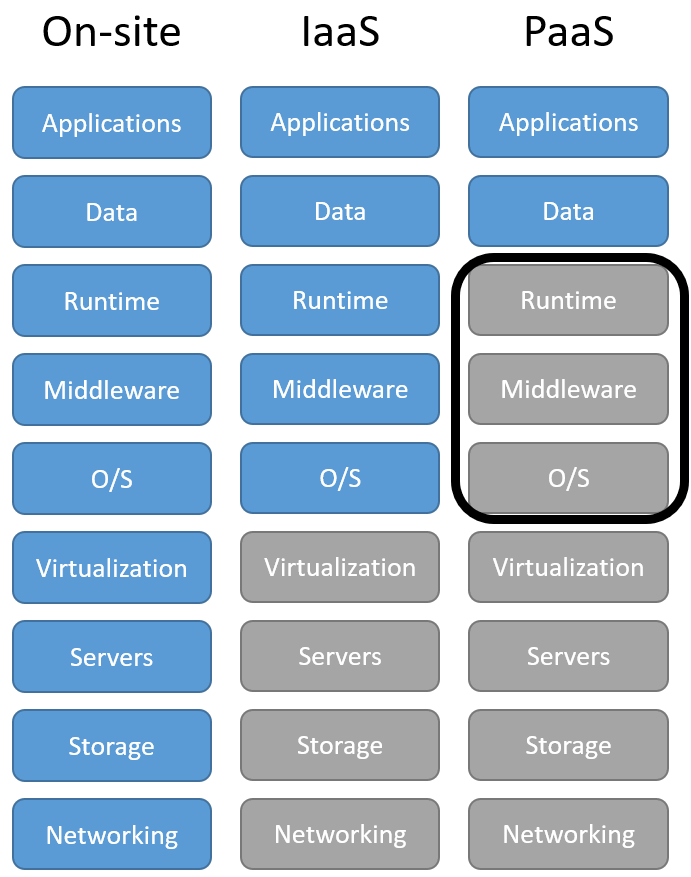
When you have to maintain your IT system without PaaS, the user works in models listed in the On-site or IaaS column – which means that the responsibility for the elements in blue boxes remain on the very user’s side; while only the ones in grey boxes are taken care of by the provider of your infrastructure. The PaaS model clearly makes a huge difference, since PCSS, as the infrastructure provider, manages basically the whole infrastructure – while the client is responsible only for the application and data.
BO: What environment are the applications deployed in?
MZ: Our client’s applications run on the PCSS managed OKD platform, based on K8s or Kubernetes, if you will. The apps’ environment can be built with high availability in mind, so failure or the lack of access to specific components ought to have a possibly minimal influence on how this service works. The Platform has also mechanisms that support a safe and stable maintenance of applications – those include: monitoring, alerts, centralised log aggregation, scaling, and deployment automation tools.
BO: What about backups?
MZ: For some elements of the environment, backup works by default, as for the rest of them it is really up to our client whether it’s on or not. The platform additionally informs about the elements which are not protected this way, hence it is easier to avoid the situation in which some important data or configuration is left without a proper backup.
BO: You have mentioned the clients, so I would like to ask who this service is aimed at.
MZ: The target group consists mainly of companies – regardless of the business field they focus on. However, we aim it also at the public sector institutions, as well as researchers and scientists. These days basically every industry has to implement and thus deploy some IT systems or Internet applications in the cloud – and to do that one needs a proper infrastructure.
BO: All of that sounds great, but the PCSS container platform is actually not a unique service. What sets it apart from similar offerings by other institutions or companies?
MZ: Indeed, the PaaS model itself isn’t unique, so similar services can be found without too much effort. The real differences emerge when you look at how much responsibility the provider actually takes on. At PCSS our prerogative is to minimize the amount of platform-related work our customers have to handle themselves. We don’t simply provide a Kubernetes environment – we add a range of integrated services and mechanisms that are necessary for applications to run smoothly on a day-to-day basis. These include monitoring, backups, continuous integration and continuous delivery tools, as well as other managed services. On top of that, our customers have direct access to support from our specialists. So what makes our PaaS unique is actually the model as a whole. We take care of all the workload connected with the platform to let our customers focus just on their applications.
BO: Similar solutions are also offered by some major global technology companies, aren’t they?
MZ: Yes, that’s true. However, a significant chunk of the global cloud services market belongs to providers from outside of the European Union. So, European customers, including the ones operating in Poland, are likely to become largely dependent on non-EU providers – and thus, also on their technological, business, and legal frameworks. The PCSS offer is, on the other hand, a local alternative. Our infrastructure is based in Poland, and our service supports the principle of digital sovereignty – in other words, that guarantees greater control over your data, infrastructure, and key technologies. That is of crucial importance for public administration, research institutions, healthcare organizations, and companies that process sensitive data. And yet there’s another advantage of having a local provider: it enables building an environment that meets the so-called RODO (GDPR) requirements – particularly when it comes to controlling where all the data is processed, choosing which entities are involved in handling it, and limiting data transfers outside the European Economic Area.
BO: Sounds convincing, but we both know that technological progress is advancing at a fast pace, so a solution that works perfectly today, tomorrow can be replaced by something better.
MZ: That’s the reason why we created our platform around widely adopted open-source technologies, such as Kubernetes and OKD. It reduces a customer’s dependence on solutions tied to a single provider and makes it easier to migrate their applications to a different environment if necessary. Of course, migrating a system always takes some time and effort, however, by using open standards, we give our customers greater freedom to choose technologies and decide how they want to develop their systems in the future.
BO: Thank you for your time, Michał. It’s been a pleasure talking to you.
MZ: The pleasure is mine. Thank you.