
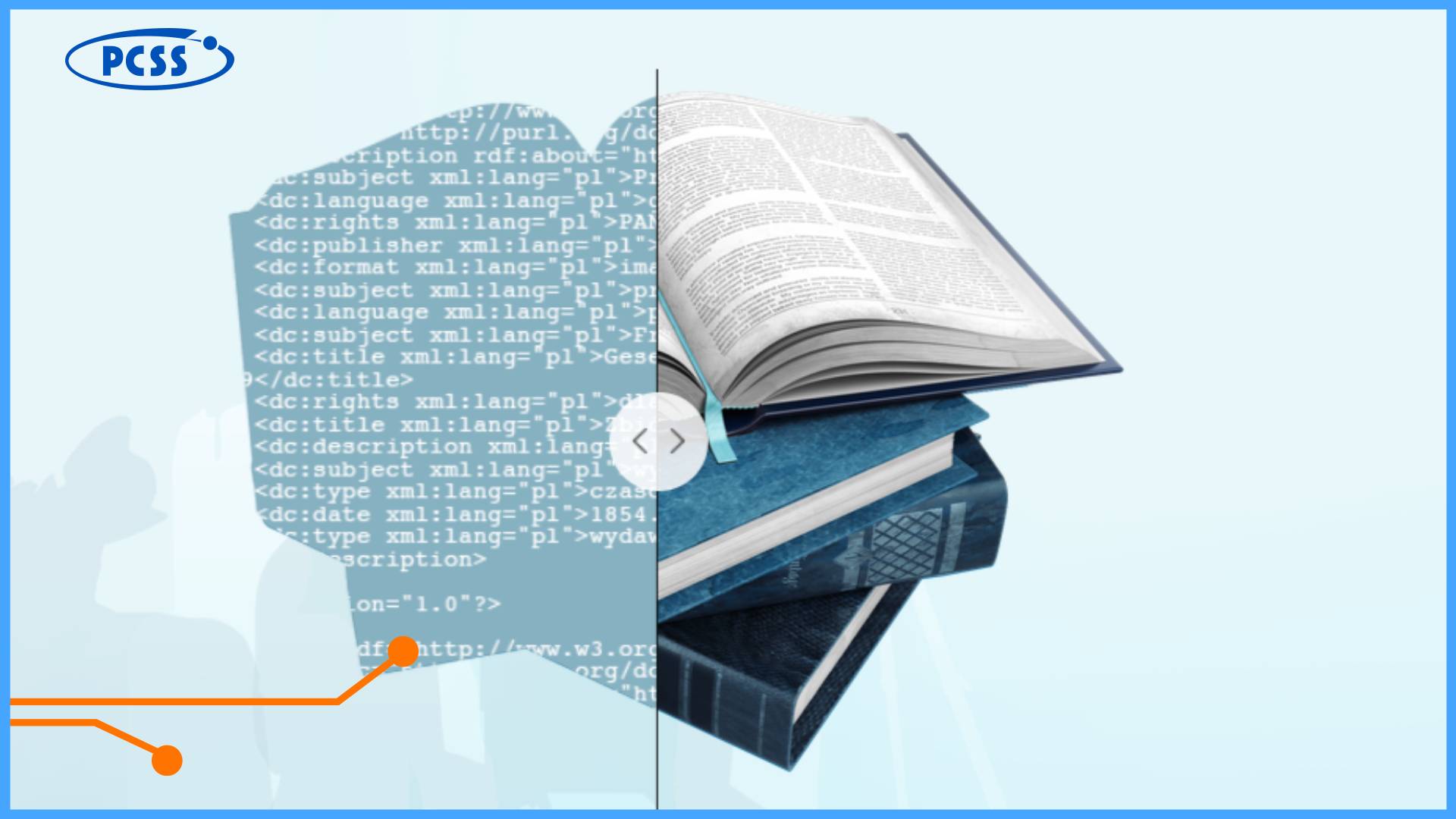
30 years ago, in order to read an ancient manuscript there was no other option but to visit the library which had it in its collection. Nowadays you can study such documents without leaving the confines of your bedroom – as long as you have a laptop or even just a smartphone, manuscripts of all kinds are just a few clicks away. It’s possible thanks to digitization – but what exactly is this phenomenon and why is it so important for the future generations? You will find the answers to those questions in Karolina Michalak’s conversation with Arleta Piwowarczyk, who represents Digital Libraries and Knowledge Platforms Department at the Poznań Supercomputing and Networking Center.
KM: Digitization is usually associated with creating a digital version of an analog entity. Most commonly, we perceive it as scanning documents. However, it seems to me that this is a far more complex process.
AP: Well, digitization does begin with scanning, but that is only the first step of the journey. I would say that it’s actually a complex process to transform a physical object into a digital one. First of all, the object we’ve chosen needs to be properly prepared, then scanned in the right way. And let’s not forget about the metadata that we have to gather in order to create a proper description – which is necessary for the digital form to be published. Legal issues also need to be taken into account, as some pieces of work that has been scanned and placed in digital libraries cannot be made available to everyone. It actually depends on the license, so there may be certain restrictions we have to comply with. Finally, we should remember that a digital library isn’t limited to storing scans of printed works — it can also hold photographs, audio and video recordings, or even 3D objects.
KM: What exactly is this metadata that you’ve just mentioned?
AP: Metadata is both basic and detailed information about a scanned object: author, title, keywords, publication date, and even the date the scan was created – everything that enables users to identify what they’re looking for. It makes the search much easier and faster.
KM: Why is the digitization of cultural and scientific resources important for future generations?
AP: Because books, documents, newspapers, and manuscripts are physical objects of a fleeting nature. They just deteriorate over time: paper crumbles, ink fades, and text becomes increasingly illegible. Digitization allows us to preserve their content and save it for the future. Even if the original piece of work is destroyed by fire or water, the content is going to survive in the digital form accessible online. Thanks to digitization, future generations will be able to explore the achievements and knowledge of those who came before them – building the future on strong fundaments created in the past.
KM: What are the most common challenges related to digitization from the perspective of cultural or scientific institutions?
AP: People and money. Such institutions frequently lack qualified staff trained in digitization, and the very process requires adequate funding. The condition of the scanned documents is also of crucial importance. The majority of those precious source materials are unfortunately worn down and fragile, so one needs to handle them with extreme care – often quite literally with white gloves on.
KM: What are the solutions developed at the Poznań Supercomputing and Networking Center in order to save all those works from disintegration?
AP: PCSS’ Digital Libraries and Knowledge Platforms team developed the DinGO suite that features key solutions designed for digitization and sharing. The flagship elements of DinGO are dLab, dArceo and dLibra systems – designed as parts of a shared environment, yet capable of operating independently of one another. Each of them handles a different stage of working with digital resources, and using them together makes it possible to build a complete synergic workflow. However, institutions can also implement only a selected component or two, depending on the needs and resources. And that’s a really great thing about them! Well, let’s go through those components one by one:
dLab is a tool for managing the digitization process. It basically organises everything: from the initial preparation of materials, all the way through to their processing. dLab’s main tasks include:
- planning and assigning digitization tasks,
- monitoring the progress of work,
- quality and completeness control of materials,
- support for production teams.
dArceo is a secure repository and digital archive, which responsible for long-term storage of digital resources. Its key functions include:
- secure archiving of masters, which in other words are source files,
- maintaining data integrity,
- compliance with digital archiving models (like OAIS),
- organisation of the archive repository.
Probably the most recognisable component of DInGO is dLibra – an independent digital library and publishing system. It was built for creating and running digital libraries or online repositories. dLibra makes it possible to:
- publish digital collections,
- search and browse resources,
- create library structures and thematic collections,
- integrate it with external systems and data-exchange standards.
dLab, dArceo, and dLibra can form a coherent digitization chain, but their architecture was built with flexibility and component independence in mind. So, depending on the needs of your institution, you can purchase and implement just one or two of them.
KM: You have mentioned 'long-term storage’ – does it mean that there actually is a deadline until which the files are available?
AP: It’s the matter of media on which these collections are stored. As most physical objects they simply wear off. Moreover, technology is in a constant state of evolving. So eventually long-term archiving means that you have to be up-to-date with both the degradation and the evolution, and that means regular checking of storage media condition, updating systems, and migrating resources whenever necessary.
KM: Who were these solutions created for?
AP: DInGO package components are used by digital libraries, state archives, museums as well as scientific and academic centers. They can be used by both small and large institutions — those with modest resources as well as those with much bigger budgets.
KM: Can you give some examples of the institutions that already implemented the DInGO solutions?
AP: Those are mainly libraries with truly substantial collections, such as the Silesian Digital Library – ŚBC or the Digital Library of Wielkopolska, which brings together collections from libraries across the region of Greater Poland. ŚBC currently holds 1 044 883 objects, the largest share of which are printed works’ scans, including periodicals. ŚBC primarily gathers publications from Lower and Upper Silesia, but it also includes collections from the Opole region, Lusatia, and even a maritime collection.
KM: Let’s go talk about the security now. The materials have been scanned and are already on the server, but how can we be sure that they are safe there?
AP: If you’re asking about unauthorized use or copyright protection, then in this case licenses serve as the safeguard for a given collection. But it’s ultimately the specific institution, or the rights holders, who decide who can access the objects and under what conditions. For example, publications may be available to readers only after logging in, or only for viewing without the option to download. Sometimes there’s an exclusive access only for students and lecturers on-site – in the library’s reading room. There’s also the option of sharing materials under a Creative Commons license — in such case the file can be downloaded and used freely.
KM: And what about a hacking attack?
AP: The responsibility for the digital collection belongs to the owner of the server it is stored on. So, if the server space belongs to the institution which is just using DinGO components, PCSS has no jurisdiction there and we can only hope that it’s cybersecurity systems are reliable. If, on the other hand, someone decides on using the hosting service offered by PCSS and the collections are located on servers that we manage, then the matter of security is, of course, on our side, and I think that I can safely – no pun intended – say there is no reason to worry.
To find out more about all the DinGO products contact the PCSS Salesteam.